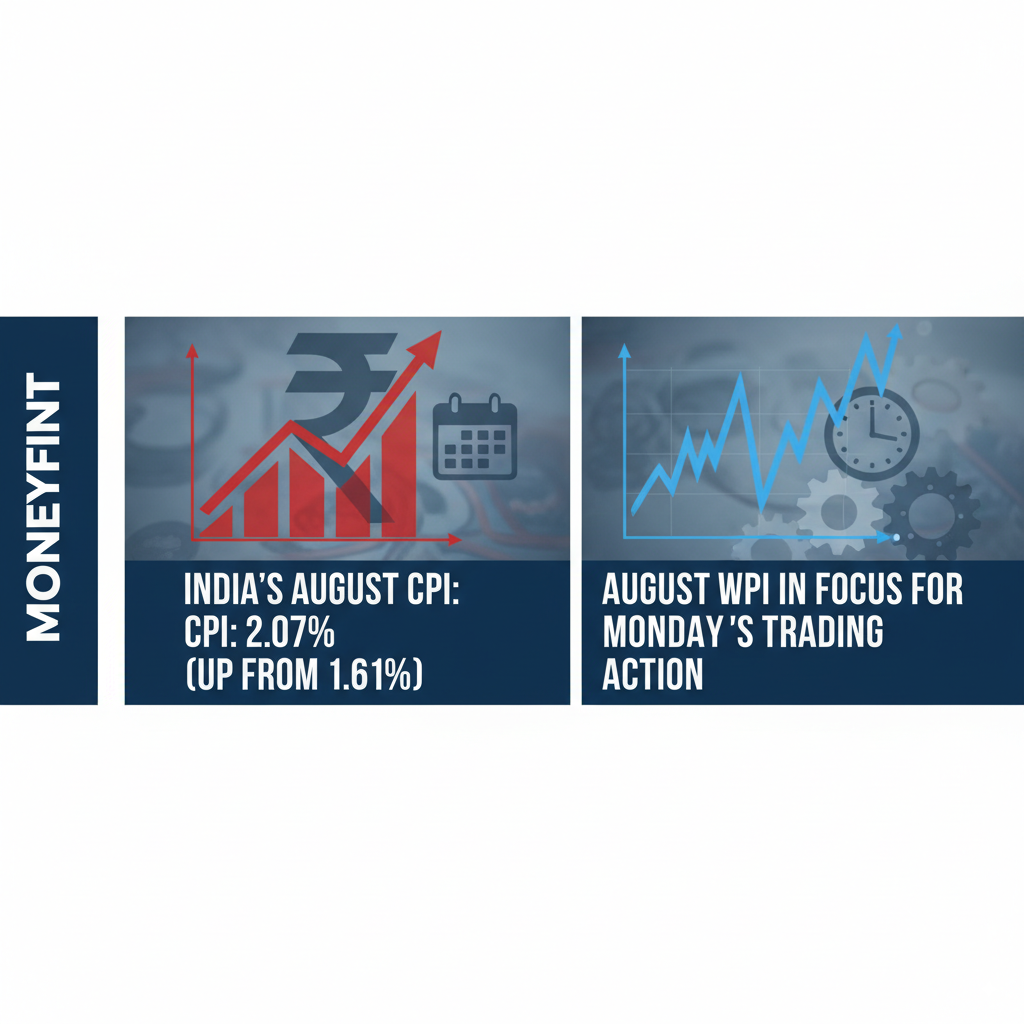
India’s retail inflation, as measured by the Consumer Price Index (CPI), rose to 2.07% year-on-year in August 2025, marking a reversal from July’s eight-year low of 1.61%. The marginal uptick in headline inflation comes at a crucial juncture for Indian markets and policy watchers, with wholesale price trends (WPI) set to influence Monday’s trading and shape the Reserve Bank of India’s approach to monetary policy. For retail investors and business leaders, these shifts carry important implications for equities, bonds, and the rupee, and offer fresh signals amid an increasingly volatile global backdrop.
The August CPI rise was primarily driven by a pronounced rebound in food inflation, which, while still negative at -0.69%, rose by over 107 basis points compared to July. This move reflected persistent upward pressure on vegetables, meat, fish, and edible oils. In contrast, fuel and light inflation moderated to 2.43% from 2.67% the previous month. Core categories showed muted movement, with clothing inflation steady at 2.33% and housing at 3.09%. A regional divergence continued, as urban inflation outpaced rural, standing at 2.47% and 1.69% respectively. The rural rebound was particularly notable in food segments, where previous deflation started to ease, influenced by both supply disruptions and monsoon variations.
Comparisons with last year highlight how dramatically price pressures have cooled: CPI stood at 3.65% in August 2024, and food inflation was running above 5% at the time. The ongoing disinflation is underpinned by softer global commodity prices, a muted pass-through of fuel hikes, and a relatively stable rupee until August’s depreciation. These dynamics are reflected in the breakdown of CPI components, with food and beverages, fuel and light, pan/tobacco/intoxicants, and core segments all showing varying degrees of deceleration and volatility.
On the wholesale price side, August WPI is expected to return to positive territory for the first time in three months, with consensus pointing to a 0.8% year-on-year print. July had logged a WPI deflation of -0.6%. The expected shift is led by rising prices of perishables—impacted by heavy rains—and global crude oil costs, compounded by the rupee’s recent softness. Unlike the CPI, the WPI is more sensitive to commodity and import price swings and often signals changes in retail inflation with a lag. Industry analysts emphasize that food articles and crude-linked products are likely to have driven the uptick, with tariffs and import dynamics adding further volatility to the wholesale basket.
For policymakers, the August CPI remains comfortably within the RBI’s 4% ±2% target band—a factor that has enabled the central bank to leave the repo rate unchanged in its latest meeting. Recent RBI bulletins and discussion papers have reiterated the focus on headline inflation while weighing if a shift toward targeting core inflation is warranted, tracking global debates in monetary circles. Economists note that the central bank is likely to look through these “one-off” spikes unless core inflation shows sustained signs of acceleration. This cautious stance aims to anchor policy credibility amid policy tightening in the US and deflationary pressures in China.
The interplay between inflation indicators and market movements was evident in August. Equities saw sector-wise churn, with FMCG and consumer durables outperforming banks and cyclicals, as investors recalibrated positions on shifting input costs and demand trends. Bond yields edged higher amid rising inflation expectations and the prospect of delayed rate cuts. The rupee weakened against the US dollar, mirroring stronger dollar dynamics and heightened import costs. Foreign Institutional Investors (FIIs) were net sellers in August, reflecting caution over global risk-off sentiment. Indian market reactions continue to be shaped by domestic inflation dynamics as well as cues from US CPI—which rose to 2.9%—and persistent deflation in China at -0.4%.
Looking back over the past six months, India’s inflation trajectory has traced a steep downward slope from about 4.26% in February to 1.61% in July, before rebounding in August. The current level remains below the country’s medium-term average and policy target. The contrast with global peers is stark: while India sits at 2.07%, the US reports 2.9%, the EU hovers around 2.6%, and China battles deflation. Domestic inflation prints reflect both global commodity trends and specific local drivers—particularly food and fuel prices that remain sensitive to weather and supply events.
Expert opinion underscores the heterogeneous nature of current inflation. “Food inflation uptick explains the August rise in CPI, but it remains within the RBI’s comfort zone…” notes a senior economist. Sector specialists add, “WPI numbers are critical as they feed into CPI with a lag, so August’s rebound in wholesale prices will be watched closely…” Policy analysts further stress, “RBI will likely look through temporary spikes unless core inflation picks up meaningfully…”—a sentiment widely echoed among market participants.
For investors, the immediate priority is to track weekly food and fuel price movements and pay close attention to RBI commentary, which may signal changing policy stances in response to core inflation. Monitoring WPI releases is equally critical, especially for sectors exposed to input cost fluctuations like consumer, auto, and staples. Currency watchers should factor rupee trends and FII flows into their strategies, as volatile global conditions add layers of complexity to Indian asset prices. For businesses, the focus remains on monitoring input costs and consumer sensitivity to price changes—a vital aspect as commodity-led inflation can quickly ripple into demand and margin dynamics.
In summary, India’s CPI inflation has emerged from historic lows as food price normalization and seasonal effects exert upward pressure, yet overall inflation remains below target and well-anchored by global and domestic disinflationary policy. RBI is expected to maintain policy stability unless core inflation resumes its climb. For market participants, continual tracking of inflation releases, RBI signals, and external shocks will remain key to investment and business decision-making over the coming quarter.