EY projects India to become the world’s second-largest economy by 2038 in purchasing‑power‑parity terms, but analysts warn that U.S. tariffs on Indian exports could trim growth and rattle markets.
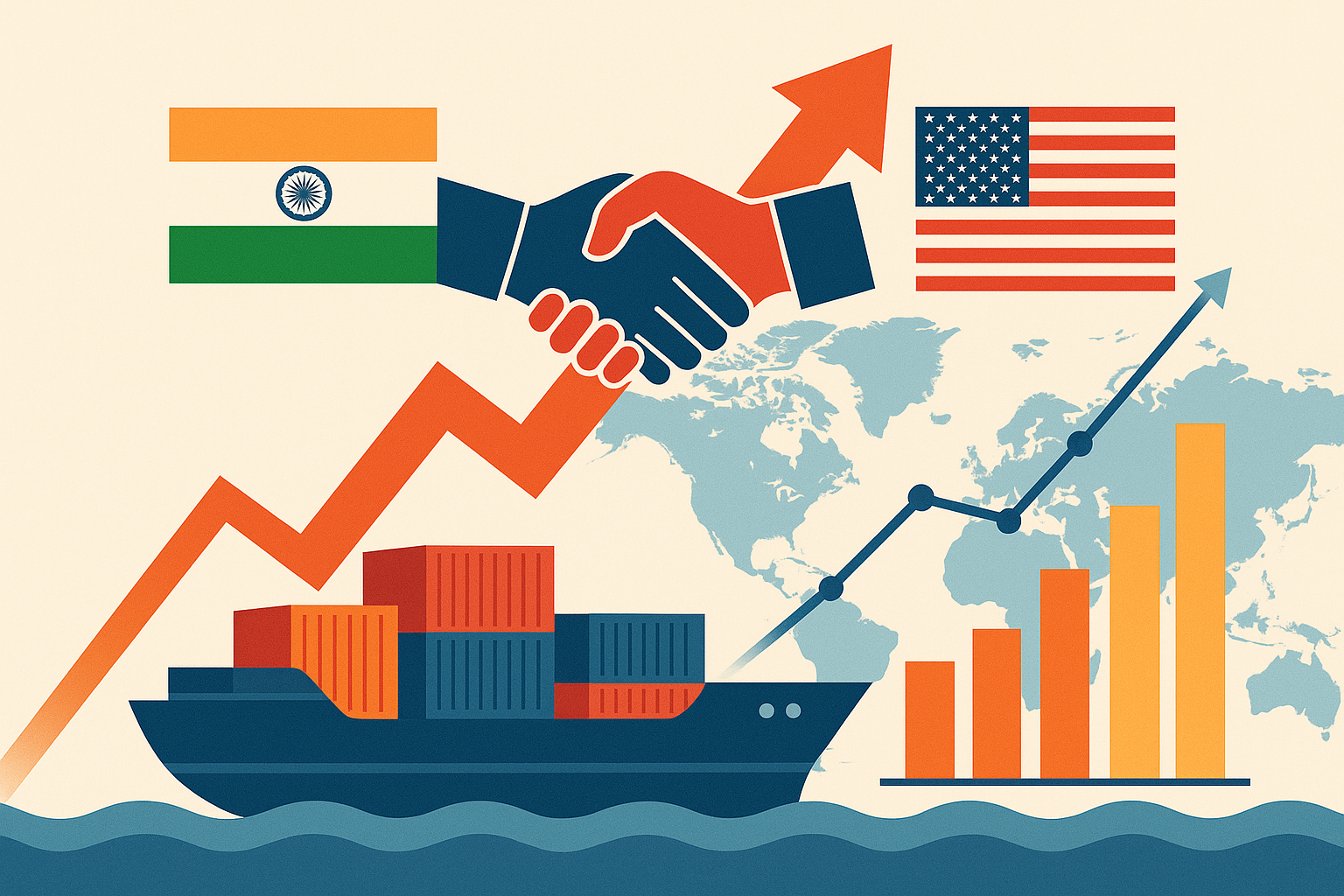
The United States’ imposition of 50 per cent tariffs on key Indian exports — from textiles and gems to auto parts and shrimp — took effect this week, sending equities lower and prompting exporters to warn of cancelled orders. The same day, Ernst & Young’s latest Economy Watch projected India’s economy could reach US$34.2 trillion in purchasing‑power‑parity (PPP) terms by 2038, overtaking the U.S. as the world’s second‑largest economydeccanchronicle.com. The juxtaposition underscores a tension between near‑term headwinds from protectionism and a long‑term narrative of demographic strength and structural reform that keeps investors focused on India’s trajectory.
Context
India has climbed the GDP league tables in recent years. According to IMF data, the country’s nominal gross domestic product is about US$4.19 trillion, making it the fourth‑largest economy after the U.S., China and Germanycleartax.in. SBI Research estimates that India will surpass Germany to become the third‑largest economy by 2028cleartax.in. EY’s report argues that, on a PPP basis, India’s GDP could reach US$20.7 trillion by 2030 and US$34.2 trillion by 2038deccanchronicle.com. The projection rests on strong fundamentals: a median age of 28.8 years, a high savings and investment rate, and a government debt‑to‑GDP ratio that is expected to fall from 81 per cent in 2024 to about 75 per cent by 2030ndtv.com. These factors underpin expectations of average annual growth of around 6.5 per cent, compared with about 2 per cent for the U.S., implying convergence over the next decadedeccanchronicle.com.
The picture is clouded by Washington’s tariff action. Following a 25 per cent “reciprocal” tariff in August, the U.S. added an extra 25 per cent levy on Indian goods loaded after 27 August, taking total duties to as high as 50 per cent for textiles, gems, jewellery, footwear and marine productsreuters.com. India’s Commerce Ministry reckons that around US$48.2 billion worth of exports — nearly 55 per cent of shipments to the U.S. — will be hitfinancialexpress.com. SBI Research notes that labour‑intensive sectors like knitted textiles face effective duties of about 63.9 per cent, while seafood exports are hit with 58.6 per cent and gems and jewellery 53.2 per centfinancialexpress.com. By contrast, pharmaceuticals and refined petroleum products are largely exempt, facing duties as low as 3.85 per centfinancialexpress.com.
Analysis
The immediate market reaction has been negative. India’s Nifty 50 index fell 0.85 per cent to 24,501 on 28 August, while the BSE Sensex slipped 0.87 per cent to about 80,081reuters.com. Small‑ and mid‑cap indices fell more than 1 per cent, and 15 of 16 sectoral indices ended lowerreuters.com. Foreign portfolio investors sold US$2.66 billion worth of equities in August, the biggest monthly outflow since Februaryreuters.com. Analysts at Antique Stock Broking warn that foreign inflows could remain under pressure, given tariff‑related uncertaintyreuters.com. Beyond equities, exporters fear order cancellations; the gems and jewellery industry derives about 40 per cent of revenue from the U.S., while seafood exporters send more than half their output therefinancialexpress.comfinancialexpress.com.
Macro‑economically, the hit may be manageable. EY estimates that roughly 0.9 per cent of India’s GDP is exposed to the higher U.S. tariffsdeccanchronicle.com. Assuming a one‑third decline in demand, the report calculates a drag of about 0.3 per cent of GDPdeccanchronicle.com. With appropriate countermeasures — such as substituting imports and boosting domestic consumption — the impact could be reduced to just 10 basis points of growthdeccanchronicle.com. That view is echoed by the Reserve Bank of India (RBI), which sees overall GDP growth around 6.5 per cent for FY26reuters.com. Private economists are more cautious: Goldman Sachs has trimmed its FY26 forecast by 20–40 basis points to about 6.1 per centreuters.com, while Citibank estimates that full tariffs could shave 40 basis points off growthreuters.com.
The policy backdrop remains supportive. Recent structural reforms — including the Goods and Services Tax (GST), the Insolvency and Bankruptcy Code and digital payments infrastructure — have improved productivity and tax compliancendtv.com. The government has also rolled out production‑linked incentive (PLI) schemes to spur manufacturing. Nomura notes that New Delhi is preparing a ₹2.5 lakh crore export‑promotion package, plans to rationalise GST slabs by September and is fast‑tracking trade talks with the EU, ASEAN and other partnersfinancialexpress.com. It expects the extra 25 per cent penalty for buying Russian oil to be lifted after November, leaving a 25 per cent reciprocal tariff in place through FY26financialexpress.com. Nomura accordingly cut its FY26 GDP forecast to 6 per cent and expects two RBI rate cuts in October and Decemberfinancialexpress.com.
Expert Commentary
Upasna Bhardwaj, chief economist at Kotak Mahindra Bank, estimates that exemptions mean the effective tariff rate is around 31 per cent and warns it could disrupt labour‑intensive sectors; she puts the annualised impact at US$25–50 billion and sees a 20–30 basis‑point downside to Kotak’s 6.2 per cent GDP forecastreuters.com. Teresa John, lead economist at Nirmal Bang Institutional Equities, calculates that the tariff shock is equivalent to about US$36 billion, or 0.9 per cent of GDPreuters.com. Radhika Rao of DBS Bank notes that India’s exports to the U.S. account for roughly 2.3 per cent of GDP; while the absolute share is modest, the impact is asymmetrical, with gems, textiles and seafood facing “trade‑embargo‑like” effectsreuters.comfinancialexpress.com. She suggests that India accelerate talks with other trade partners and rely on domestic consumption and policy easing to cushion the blowreuters.com. Sujan Hajra of Anand Rathi Group warns that tariffs could widen the trade deficit by about 0.5 per cent of GDP and cost up to two million jobs but emphasises that robust domestic demand and diversified exports should limit the growth impact to around half a percentage pointreuters.com.
DK Srivastava, EY India’s chief policy advisor, argues that India’s young and skilled workforce, high savings rate and relatively sustainable debt profile provide resiliencedeccanchronicle.com. Even with tariffs, he estimates that the growth impact can be contained to around 0.1 percentage pointdeccanchronicle.com. Nomura’s analysts add that government support — including credit guarantees, GST rationalisation and export diversification — should mitigate medium‑term risksfinancialexpress.com.
Retail Investor Impact
For retail investors, the tariff shock has created short‑term volatility. Equity benchmarks have fallen about 2 per cent over two sessions, with export‑oriented stocks such as textiles, jewellery and seafood under particular pressurereuters.com. Foreign institutional investors pulled out over US$2.6 billion in Augustreuters.com, signalling risk aversion. Investors with exposure to export‑heavy companies may consider trimming positions or hedging, while those focused on domestic consumption and infrastructure may benefit from resilience in pharmaceuticals, energy and electronics, which face minimal tariffsfinancialexpress.com. Bond markets could get a tailwind if the RBI delivers rate cuts; lower borrowing costs may support housing and auto demand. Currency volatility may persist if the trade deficit widens, but India’s ample forex reserves and remittance inflows provide a cushion.
What’s Next
Attention now shifts to diplomacy and policy. Trade negotiations with the U.S. could remove the 25 per cent penalty by Novemberfinancialexpress.com, though the reciprocal 25 per cent tariff may persist. India is also fast‑tracking free‑trade agreements with the EU, ASEAN, Oman and Chile, which could open alternative markets for exportersfinancialexpress.com. Domestically, investors will watch the RBI’s monetary policy meetings in October and December, where analysts expect two 25‑basis‑point rate cutsfinancialexpress.com. September’s GST council meeting, which may rationalise tax slabs, is another catalyst. Later in the year, the Q2 FY26 GDP print and corporate earnings will reveal whether the tariff shock has materially slowed growth. Even with near‑term turbulence, the long‑term thesis that India could overtake the U.S. in PPP terms by 2038 remains intactdeccanchronicle.com.