
The enterprise software landscape is witnessing a fundamental shift as artificial intelligence evolves from simple productivity assistance to autonomous workflow management. Agentic AI—systems capable of planning, executing, and adapting independently across complex business processes—has emerged as the next frontier beyond traditional copilots and chatbots. Unlike previous generations of AI tools that required constant human oversight, agentic systems operate with predetermined goals, make contextual decisions, and orchestrate multi-step workflows with minimal intervention.
Q4 2025 represents the inflection point for enterprise agentic AI adoption, driven by converging market forces that have transformed theoretical concepts into production-ready solutions. McKinsey’s latest enterprise AI research indicates that 79% of organizations now report some level of AI agent adoption, with 43% of companies allocating over half their AI budgets specifically to agentic capabilities. This dramatic resource shift reflects boardroom recognition that autonomous AI systems deliver measurable returns on operational efficiency, cost reduction, and revenue acceleration—moving beyond the experimental phase into strategic business transformation.
The catalyst for this Q4 acceleration stems from three critical developments: infrastructure cost curves have improved dramatically, making on-device and hybrid inference economically viable; governance frameworks have matured to address regulatory compliance and risk management; and enterprise pilots conducted throughout 2025 have demonstrated quantifiable ROI metrics that satisfy CFO scrutiny. Organizations that postponed agentic AI deployments are now facing competitive pressure as early adopters report significant operational advantages across finance, customer operations, and IT security domains.
Enterprise Use-Cases Driving Adoption
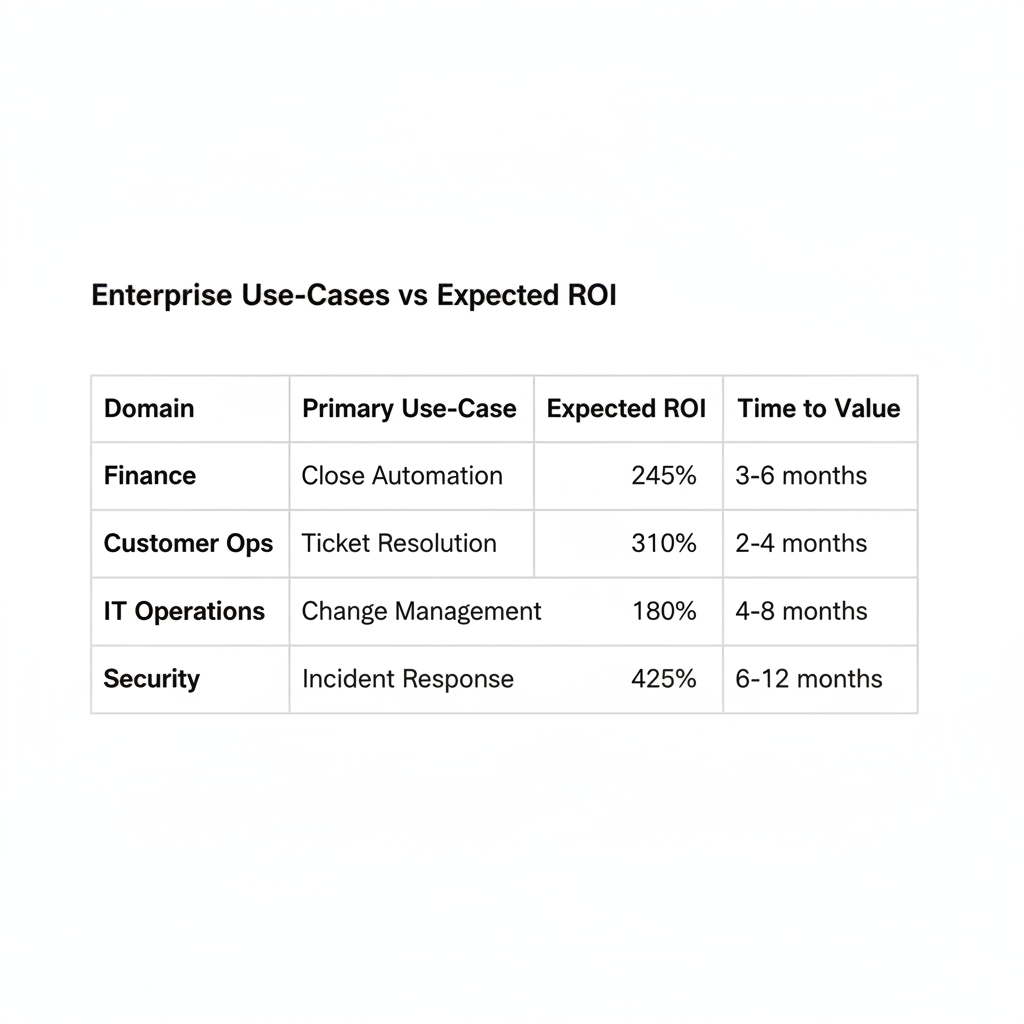
Finance departments represent the most mature deployment area for agentic AI, with autonomous systems handling month-end close automation, variance analysis, and vendor reconciliation workflows. Leading enterprises report 65% reduction in close cycle times as AI agents automatically reconcile intercompany transactions, identify discrepancies, and route exceptions to human analysts only when threshold limits are exceeded. These systems integrate directly with ERP platforms, accessing real-time transaction data to perform continuous reconciliation rather than batch processing, effectively eliminating the traditional month-end bottleneck.
Customer operations teams are deploying agentic AI for autonomous ticket triage and resolution, moving beyond simple chatbots to systems that can diagnose technical issues, access knowledge bases, coordinate with backend systems, and escalate complex cases with full context preservation. Enterprises report 78% first-contact resolution rates for technical support queries, compared to 45% with traditional helpdesk automation. These agents operate across multiple channels—email, chat, voice, and social media—maintaining conversation context and customer history throughout interaction sequences.
IT and security operations have emerged as high-value deployment areas where agentic AI manages change requests, automated patching, and security alert handling. These systems can analyze infrastructure dependencies, schedule maintenance windows, coordinate with affected stakeholders, and execute rollback procedures if anomalies are detected. Security-focused agents process threat intelligence feeds, correlate alerts across multiple tools, initiate containment procedures, and generate incident reports—reducing mean time to response from hours to minutes while maintaining detailed audit trails for compliance requirements.
Reference Architecture: The Foundation for Autonomous Operations
Enterprise agentic AI deployments follow a standardized architecture pattern combining Retrieval-Augmented Generation (RAG), tool integration, and policy enforcement layers. The RAG component enables agents to access current business context, company policies, and procedural knowledge, ensuring decisions align with organizational standards and regulatory requirements. This knowledge layer connects to real-time data sources including CRM systems, financial databases, inventory management platforms, and external APIs, providing agents with comprehensive situational awareness.
Tool integration represents the operational layer where agents execute actions across enterprise systems through APIs, RPA automation, and direct database connections. Modern agentic platforms support hundreds of pre-built connectors for major business applications, allowing seamless workflow orchestration without custom development. The policy enforcement layer implements governance controls, defining authorized actions, approval thresholds, escalation triggers, and audit requirements that ensure autonomous operations remain within acceptable risk parameters.
Infrastructure decisions between on-device and cloud inference depend on specific use case requirements, with latency-sensitive operations favoring edge deployment while complex reasoning tasks leverage cloud-based large language models. Enterprises typically implement hybrid architectures where routine tasks execute locally for speed and cost optimization, while complex decision-making utilizes cloud resources for advanced analytical capabilities. Observability and monitoring systems provide real-time visibility into agent performance, decision rationale, and operational metrics—essential for maintaining accountability and continuous improvement.
Build vs Buy: Strategic Decision Framework
CTOs and CIOs evaluate build versus buy decisions across five critical dimensions: domain complexity, data gravity, compliance requirements, total cost of ownership, and time-to-value considerations. Organizations with highly specialized workflows, unique data structures, or proprietary business logic often favor custom development to achieve optimal integration and performance. However, building agentic AI systems requires significant investment in machine learning expertise, infrastructure management, and ongoing model maintenance—resources that may be better allocated to core business activities.ibm+1
Commercial agentic AI platforms offer accelerated deployment timelines, pre-built integrations, and professional support services that reduce implementation risk and operational overhead. Leading vendors provide industry-specific templates, compliance frameworks, and governance tools that address common enterprise requirements. The key evaluation criteria include platform flexibility for customization, integration ecosystem breadth, scalability for enterprise workloads, security and compliance certifications, and vendor stability for long-term partnership viability.
Governance and Risk: Building Trustworthy Autonomous Systems
Enterprise agentic AI governance frameworks address transparency, accountability, and regulatory compliance requirements that become critical as systems operate with increased autonomy. Modern governance platforms provide model explainability tools, decision audit trails, and performance monitoring capabilities that satisfy internal compliance requirements and external regulatory scrutiny. These systems implement role-based access controls, approval workflows for high-impact decisions, and automatic escalation procedures when confidence thresholds are not met.ai21+1
Risk mitigation strategies focus on four primary areas: data security and privacy protection, bias detection and fairness monitoring, operational reliability and failsafe mechanisms, and regulatory compliance across multiple jurisdictions. Enterprises implement multi-layered security controls including data encryption, access logging, and network segmentation to protect sensitive information processed by AI agents. Bias monitoring systems continuously evaluate agent decisions for fairness across demographic groups, business units, and customer segments, with automatic alerts when statistical anomalies are detected.
Quick CIO Checklist: 3 Critical Questions Before Deployment
- Can we explain every autonomous decision to auditors and stakeholders? Ensure comprehensive logging, decision rationale capture, and explainability tools are implemented.
- What happens when the AI agent makes a mistake? Define escalation procedures, rollback capabilities, and human override mechanisms for all critical workflows.
- How do we measure success beyond cost savings? Establish KPIs for quality, compliance, customer satisfaction, and employee experience improvements.
KPI Framework and ROI: Measuring Autonomous AI Success
Enterprise leaders require comprehensive measurement frameworks that capture both quantitative and qualitative benefits of agentic AI deployments. Primary ROI metrics include time saved per workflow, cost per task reduction, error rate improvements, and revenue enablement through faster customer response times. Leading organizations report average ROI of 3.7x within 12 months, with top performers achieving 10x returns through strategic deployment across high-impact workflows.
Operational KPIs focus on containment rates for customer service interactions, workflow completion times, accuracy measurements, and user adoption metrics that indicate system effectiveness and organizational change management success. Soft benefits including employee satisfaction improvements, decision-making speed enhancement, and strategic agility increases provide additional value that supports long-term competitive advantage but requires qualitative measurement approaches.
CFOs and CIOs should establish measurement frameworks before deployment, defining baseline metrics, success criteria, and reporting schedules that align with quarterly business reviews and annual planning cycles. Continuous monitoring systems provide real-time visibility into agent performance, enabling rapid optimization and scaling decisions based on empirical evidence rather than theoretical projections.
Action Plan for Q4: 30-60-90 Day Implementation Roadmap
The first 30 days require sandbox deployment, workflow mapping, and risk assessment activities that establish foundation requirements for scaled implementation. Organizations should identify 2-3 pilot use cases with clear success metrics, establish governance committees with cross-functional representation, and complete initial security and compliance reviews. Technical teams focus on infrastructure preparation, integration planning, and initial model training using historical workflow data.
Days 60-90 involve red team security testing, staged production deployment, and governance framework implementation with real business workflows. This phase includes user training programs, change management activities, and performance monitoring system deployment. Organizations expand from pilot users to broader departmental adoption, with careful monitoring of system performance, user feedback, and business impact measurements.
The final 90-day milestone represents scaled rollout with comprehensive monitoring, staged autonomy increases, and ROI tracking across all deployed use cases. Successful implementations demonstrate measurable business value, established governance procedures, and organizational readiness for expanding agentic AI deployment to additional business functions and use cases.
This Means for Jobs and Markets
For employees, agentic AI deployment typically augments rather than replaces human workers, with job roles evolving toward higher-value strategic activities, exception handling, and creative problem-solving tasks. Market opportunities emerge across AI governance consulting, system integration services, and specialized training programs as enterprises require expertise for successful deployment. Investment opportunities concentrate in companies demonstrating measurable agentic AI ROI, particularly in finance, healthcare, and customer service sectors where autonomous operations deliver quantifiable business value.
Summary box
Agentic AI has transitioned from experimental technology to enterprise-grade business transformation tool, with Q4 2025 marking the definitive shift from pilot projects to production deployments at scale. Organizations implementing comprehensive governance frameworks, measuring ROI across multiple dimensions, and following structured deployment methodologies report significant competitive advantages through operational efficiency, cost reduction, and customer experience improvements. As 96% of enterprises plan to expand AI agent usage in 2026, Q4 2025 represents the last opportunity for organizations to join the early adopter cohort before agentic AI becomes a baseline competitive requirement rather than a differentiating advantage.