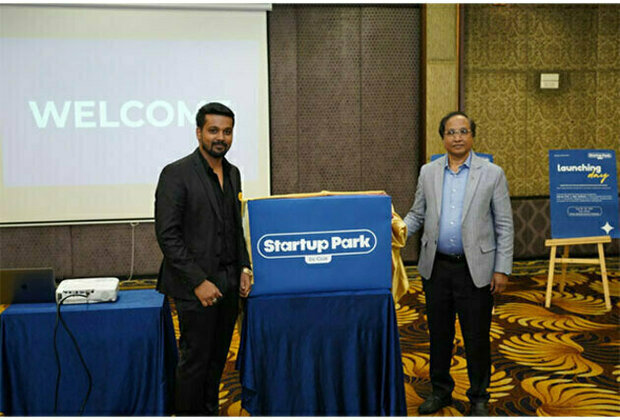
Bengaluru: IQue Ventures on Monday announced the launch of India’s first dedicated “Startup Park” innovation hub, a ₹600 crore initiative aimed at nurturing early-stage ventures across technology, fintech, deeptech, and consumer internet. The park, spread over 25 acres in Bengaluru’s northern corridor, is set to open doors in September 2025, positioning itself as a one-stop ecosystem for founders seeking capital, mentorship, and market access.
The launch comes alongside the firm’s latest Series B funding round, where IQue Ventures raised ₹600 crore (~$72 million) from a consortium of domestic and global investors including Accel India, Peak XV Partners, and Singapore’s GIC. The round values the company at ₹4,200 crore (~$500 million), nearly doubling from its previous valuation of ₹2,100 crore in late 2023.
A Bet on Early-Stage India
Founded in 2021 by former venture capitalist Arjun Mehra and technologist Neha Kapoor, IQue Ventures operates as a venture-building platform. Its core model blends capital deployment with incubation infrastructure. Unlike traditional VCs that primarily write cheques, IQue embeds startups into sector-focused clusters where founders can access shared R&D facilities, co-working, legal and compliance support, and structured mentorship from industry veterans.
The newly announced Startup Park aims to house over 200 startups in its first phase. Each resident venture will receive access to seed-to-Series A funding, pilot programs with corporate partners, and cloud infrastructure credits from partners like Amazon Web Services and Microsoft Azure.
“This is not just about real estate—it’s about building an innovation city within the city,” said Arjun Mehra, co-founder and CEO of IQue Ventures. “With this fundraise, we are creating a long-term platform that ensures early-stage founders don’t struggle for resources or networks. Bengaluru has been the birthplace of India’s startup movement; we are now giving it a structured home.”
Market Opportunity: TAM and SAM
India’s startup ecosystem has swelled to over 1,25,000 registered startups, according to DPIIT data, with more than 110 unicorns. Yet, analysts note that infrastructure bottlenecks and limited early-stage capital remain persistent hurdles.
- TAM (Total Addressable Market): The broader Indian startup support ecosystem—covering accelerators, co-working, and venture services—is estimated at $15–20 billion by 2030.
- SAM (Serviceable Available Market): Within this, incubation hubs catering to seed and Series A companies account for $2.5–3 billion annually, growing at a 25% CAGR as more founders seek structured scale-up support.
IQue Ventures is targeting a 5–7% market share in SAM over the next five years, translating into a potential revenue pool of ₹1,200–1,500 crore annually by FY2030.
Traction and Monetization
IQue currently supports 72 portfolio companies, spanning AI in healthcare, EV charging infra, consumer SaaS, and agritech. Its model monetizes through three channels:
- Equity stakes (average 7–10% ownership in incubated ventures).
- Rental and services revenue from park facilities (co-working, labs, compliance services).
- Success fees from exits or secondary share sales.
In FY2024, IQue Ventures reported ₹120 crore in topline revenue, up 3.5x year-on-year. Portfolio companies collectively generated ₹950 crore in GMV, with five ventures crossing ₹100 crore in ARR.
“Monetization is baked into the model without burdening startups with high costs,” said Neha Kapoor, co-founder and COO. “We see ourselves as partners, not landlords.”
The New Round: Deployment and Expansion
The ₹600 crore Series B round will be deployed across three buckets:
- 60% (₹360 crore): Building and operationalizing the Bengaluru Startup Park hub.
- 25% (₹150 crore): Direct early-stage investments into seed and Series A startups.
- 15% (₹90 crore): Expanding to secondary hubs in Hyderabad and Pune by 2026.
“Our focus is to create a pan-India innovation corridor,” Mehra added. “Bengaluru is the first anchor, but by 2026 we want to replicate this model in at least three Tier-1 and Tier-2 cities.”
Competitive Landscape
India’s incubation market is currently dominated by state-run hubs (Karnataka Startup Mission, T-Hub Hyderabad) and private accelerators (Sequoia’s Surge, Y Combinator India). However, most operate as accelerators with limited physical infrastructure.
IQue’s hybrid model—blending venture capital, incubation, and real estate—sets it apart. Analysts note that it competes indirectly with WeWork India, 91Springboard, and state-backed tech parks, but its equity-plus-services approach is more aligned with Founders Factory UK or Station F Paris.
“Globally, startup hubs are moving beyond co-working into full-stack support systems,” said Anita Rajan, Partner at KPMG India. “IQue Ventures’ Startup Park aligns with this evolution and could be a template for other emerging markets.”
Prior Rounds and Investor Confidence
Before this Series B, IQue raised:
- Seed (2021): ₹45 crore from angels including Sanjeev Bikhchandani and Kunal Shah.
- Series A (2023): ₹210 crore led by Accel India, valuing it at ₹2,100 crore.
The new round’s near-2x valuation jump in 18 months signals investor confidence despite a funding winter that has hit Indian startups since 2022.
Risks and Challenges
While optimism runs high, analysts caution against risks:
- Unit Economics: Equity returns are inherently long-tail. Sustaining park revenues while waiting for portfolio exits may strain cash flows.
- Regulatory Risk: Land use and real estate approvals in Bengaluru’s northern corridor could delay construction timelines.
- Competition: Global accelerators entering India (Techstars, Plug & Play) may pressure IQue to scale faster.
- Founder Dependency: Success hinges on a handful of high-growth portfolio companies delivering exits in 5–7 years.
The rise of venture studios and builders reflects a shift in India’s startup culture. According to Bain & Co, venture studios grew 2.8x in India between 2020–2024, as founders prefer shared services over building everything in-house.
“Capital alone is no longer the differentiator,” said Rajat Tandon, President of IVCA. “The future belongs to platforms that blend money with market access, mentoring, and infrastructure. IQue’s Startup Park is timely in this context.”
The Bengaluru Startup Park is a bold bet—a ₹600 crore wager on India’s early-stage economy. If executed well, it could reduce friction for thousands of founders, catalyse job creation, and help Indian startups scale globally. But execution risk, regulatory bottlenecks, and the inherent unpredictability of venture returns mean outcomes will only be visible over the medium term.
For now, IQue Ventures has secured its war chest, its marquee investors, and its blueprint. The next test will be turning 25 acres of promise into a living, breathing innovation hub.